Stomach Cancer
Saint Luke’s Cancer Specialists provide early detection, expert diagnosis, personalized treatment options, and survivorship support to every patient.
What Is Stomach Cancer?
Cancer starts when cells in the body change (mutate) and grow out of control. These cells can form lumps called tumors. Cancer that starts in the cells of the stomach is called stomach or gastric cancer.
Understanding the stomach
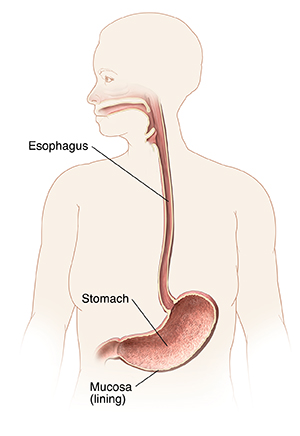
The stomach is the sac that holds and helps digest food. The wall of the stomach is made of many layers of tissue.
When food is swallowed, it goes down a tube called the esophagus. The esophagus carries it to the stomach. The stomach adds chemicals and fluids to food that help start the process of digestion. There's a strong muscle layer of the stomach wall. It squeezes and mixes the contents to make it soft. Food then leaves the stomach and goes into the small intestine.
When stomach cancer forms
Stomach cancer almost always starts in the stomach’s innermost layer or lining, called the mucosa. This type of stomach cancer is called adenocarcinoma.
Cancer cells can then spread deeper into the other four layers of the stomach. If cancer cells reach the stomach’s outer layer, they can spread into nearby organs.
Stomach cancer can also spread to other parts of the body. This spread is called metastasis. The more cancer spreads, the harder it is to treat.
Treatment choices for stomach cancer
Treatment depends on several things. They include the type and stage of stomach cancer, possible side effects, your overall health, and your preferences. You and your healthcare provider will decide on the treatment plan that’s best for you. It's common to get more than one type of treatment. Your treatment choices may include:
- Surgery to remove the tumor or the part of the stomach with cancer along with some nearby tissue. Sometimes the whole stomach must be removed (called gastrectomy).
- Chemotherapy (chemo) uses strong medicines that kill cancer cells. Many times, a combination of medicines is used. Chemo is often given before and after surgery. It can also be given along with radiation. If chemo is given before surgery, it is called neoadjuvant chemotherapy. If given after surgery, it is called adjuvant chemotherapy. When chemotherapy is combined with radiation therapy, it is called chemoradiation.
- Targeted therapy uses medicines that focus on specific features or changes in the cancer cells. This helps save normal cells while targeting and killing cancer cells. It may be used for advanced stomach cancer.
- Immunotherapy may also be used for advanced stomach cancers alone or with other treatments. These medicines boost the natural immune system so it can better find and kill cancer cells.
- Radiation therapy uses focused beams of energy from X-rays or other radiation sources, to kill cancer cells. It may be used before or after surgery.
- Clinical trials is medical research used to test new ways to treat cancer. Ask your healthcare provider if there are clinical trials you should consider as a treatment choice.
What are the symptoms of stomach cancer?
The symptoms of stomach cancer vary from person to person. Cancer in early stages may have mild or no symptoms. The symptoms may also be like those of other diseases or conditions.
The most common symptoms of stomach cancer include:
Indigestion or heartburn
Feeling like food gets stuck in your throat when eating
Stomach pain or discomfort above the level of your navel
Feeling of fullness or bloating after eating even small amounts of food
Nausea and vomiting (this often happens soon after eating)
Vomiting blood
Diarrhea or constipation
Blood in your stool
Loss of appetite
Unexplained weight loss
Weakness and tiredness
Stomach cancer that’s more advanced can block your stomach or intestines. This can cause vomiting that doesn’t go away. Stomach cancer can also spread to your liver. If this happens, it can cause yellowing of your skin and the white part of your eyes (jaundice). Or it can cause fluid buildup in your belly (ascites).
When to see your healthcare provider
Many of these symptoms may be caused by other health problems. So it's important to see your healthcare provider if you have these symptoms. Your healthcare provider will examine you and order tests to find out if you have stomach cancer.
How is stomach cancer diagnosed?
If your doctor thinks you might have stomach cancer, you'll need certain exams and tests to be sure. Diagnosing stomach cancer starts with your doctor asking you questions. You'll be asked about your health history, your symptoms, risk factors, and family history of disease. Your doctor will also do a physical exam.
What tests might you need?
If signs are pointing to stomach cancer, you may have one or more of these tests:
- Fecal occult blood test (FOBT)
- Blood tests
- Upper endoscopy
- Upper GI series
- Biopsy
Lab tests
Fecal occult blood test (FOBT)
This test is used to check for hidden blood in your stool. A small amount of your stool is put on a plastic slide or a special type of paper. You may do this test at home. Stomach cancer can sometimes cause small amounts of bleeding. This can be hard to see. But other problems that aren't cancer can also cause it. Even if the test shows blood in your stool, you'll likely need more tests to find the cause.
Blood tests
Blood tests can check if you have low red blood cell counts. This could be due to bleeding in your stomach. Blood tests can also be used to see how well certain organs are working and to get an idea of what your overall health is like. Tumor marker levels for CA19-9 and CEA may be checked. These markers are sometimes made by stomach cancer. And their levels may be higher at diagnosis.
Endoscopic tests
Upper endoscopy
This test is also called an EGD (esophagogastroduodenoscopy). It's a common procedure used to look for stomach cancer. It's often the first test done.
This test lets your doctor look at the inside of your stomach. A long, thin, flexible, lighted tube (endoscope) is used to do this. First, you are given medicines to make you sleepy. A numbing medicine is sprayed into your throat to help keep you from gagging. Then the scope is put in through your mouth and is passed down your food pipe (esophagus) and into your stomach. A camera on the end lets your doctor look at your stomach lining. The doctor also checks the lining of your esophagus and part of the first section of your small intestine (duodenum).
If your doctor sees any abnormal changes in the tissue, small pieces (called samples) of the changed tissue can be taken out through the scope. They're then examined under a microscope for cancer cells by a pathologist. This is called an endoscopic biopsy.
Imaging tests
Upper GI series
This is also called a barium swallow. It uses X-rays to find even small changes in your stomach lining. This test might be useful in some situations. It is used less often than an upper endoscopy since a biopsy can't be done during the test and it may miss some abnormal areas in the stomach. For this test, you'll drink a thick, chalky fluid with barium in it. The barium lines your stomach. This makes it easier to see on an X-ray.
To look for very small tumors, your doctor may use a double-contrast method. For this, a small tube is placed in your stomach after you drink the barium. Air is then pumped through the tube into your stomach. The air makes the barium coating thinner around the inside of your stomach. This helps tiny changes in your stomach lining show up on the X-rays.
Biopsy
A biopsy means that your doctor takes out small pieces of abnormal tissue from your stomach. A pathologist does tests on the tissue samples and looks at them under a microscope. It's the only way to know if a change is stomach cancer. But a biopsy can also show other problems. These can include an H. pylori bacterial infection, other diseases besides cancer, or another type of cancer called a lymphoma.
A biopsy is needed to confirm a diagnosis of stomach cancer.
Endoscopic stomach biopsy
This is the most common type of biopsy used. Before the procedure, you're given medicine to help you relax and a numbing medicine is sprayed into your throat. It helps prevent gagging. Then your doctor puts a long, thin, flexible tube called an endoscope into your mouth. It's guided down your esophagus and into your stomach. Your doctor looks at the lining of your stomach with the scope. Tools can be passed through the scope to take tissue samples for a biopsy from any abnormal areas.
Endoscopic ultrasound-guided needle biopsy
This procedure may be used if your doctor thinks the cancer is deeper in the wall of your stomach (not just in the stomach lining).
This test also uses an endoscope. You'll be given medicine to help you relax. A numbing medicine is sprayed into your throat to help prevent gagging. The endoscope is then put into your mouth and guided into your stomach. This scope has a special ultrasound tool at the tip. The ultrasound tip is put against your stomach wall to create images.
Your doctor looks at your stomach lining with the scope. They can also see images of the deeper layers of your stomach, lymph nodes, and other nearby tissues. If abnormal changes in the tissues are seen, your doctor will pass a thin, hollow needle through the scope into the abnormal tissue. This needle is used to take out tiny pieces of tissue to test in the lab.
Getting your test results
Your doctor will contact you with your biopsy results. Your doctor will talk with you about other tests, such as CT scans, that you may need if stomach cancer is found. Make sure you understand the results and what follow-up you need.
Learning about your treatment choices
There are different treatment choices for stomach cancer. Which may work best for you? It depends on many things, such as:
The tumor's size and location
Test results
Stage of the disease
Your overall health
Your age
Your personal needs and concerns
What side effects you find acceptable
You may also want to know how you’ll feel and function after treatment, including if you’ll have to change your normal activities.
Your healthcare provider is the best person to answer your questions. They can tell you what your treatment choices are, how well they’re expected to work, and what the risks and side effects are. Your provider may advise a certain treatment plan. It may include different types of treatment. Or they may offer more than one, and ask you to decide which one you’d like to use. It can be hard to make this decision. So it's important to take the time you need to make the best decision.
Types of treatment for stomach cancer
Here is an overview of the treatment choices for stomach cancer:
Surgery
This is the most common treatment for stomach cancer. The goal is to remove the entire tumor and any cancer cells that may have spread to nearby tissue. If the cancer is only in your stomach, surgery may be all that you need. Or you may have surgery before or after another treatment is used to shrink the tumor first.
Radiation therapy
This treatment uses high-energy beams of X-rays or particles to kill cancer cells. The main goal of radiation is to kill cancer cells and reduce the chance the cancer will come back (recurrence). Sometimes it’s used to reduce the symptoms of cancer. These can include pain, blockages, or bleeding.
Chemotherapy
The goal of chemotherapy (chemo) might be to shrink a tumor, destroy cancer cells, ease symptoms from the cancer, or help prevent cancer recurrence. Chemo is often used for early-stage stomach cancer, which has not spread. It may be the main treatment if the cancer has spread beyond the stomach to other parts of the body. Chemo can be used before surgery (neoadjuvant therapy). Or it may be given after surgery (adjuvant therapy). Chemo may be combined with radiation therapy (chemoradiation).
Targeted therapy
These are medicines that target stomach cancer cells rather than all stomach cells. These medicines work differently from regular chemo medicines. They only work if your cancer cells have particular gene mutations or express a protein that one of the current medicines can target. Your healthcare provider will look for biomarkers in your tumor to see if you are a candidate for targeted therapy.
Immunotherapy
This treatment uses medicines to help your body's immune system find and kill cancer cells. Immunotherapy may be given alone or with other types of treatment. It may be a choice for more advanced stomach cancer.
Making treatment decisions
Your healthcare provider may advise that you have more than one of these types of treatment. This is sometimes called combination therapy. Newer types of treatment may be available only through a research study (clinical trial). Talk with your provider about what clinical trials may be a choice for you.
Deciding on the best plan may take some time. Talk with your healthcare provider about how much time you can take to explore your choices. You may want to get another opinion before deciding on your treatment plan. Your provider can help you with this. You may also want to include your family and friends in this process.