Innovative Stroke Protocol Helps Bill Make Up for Lost Time
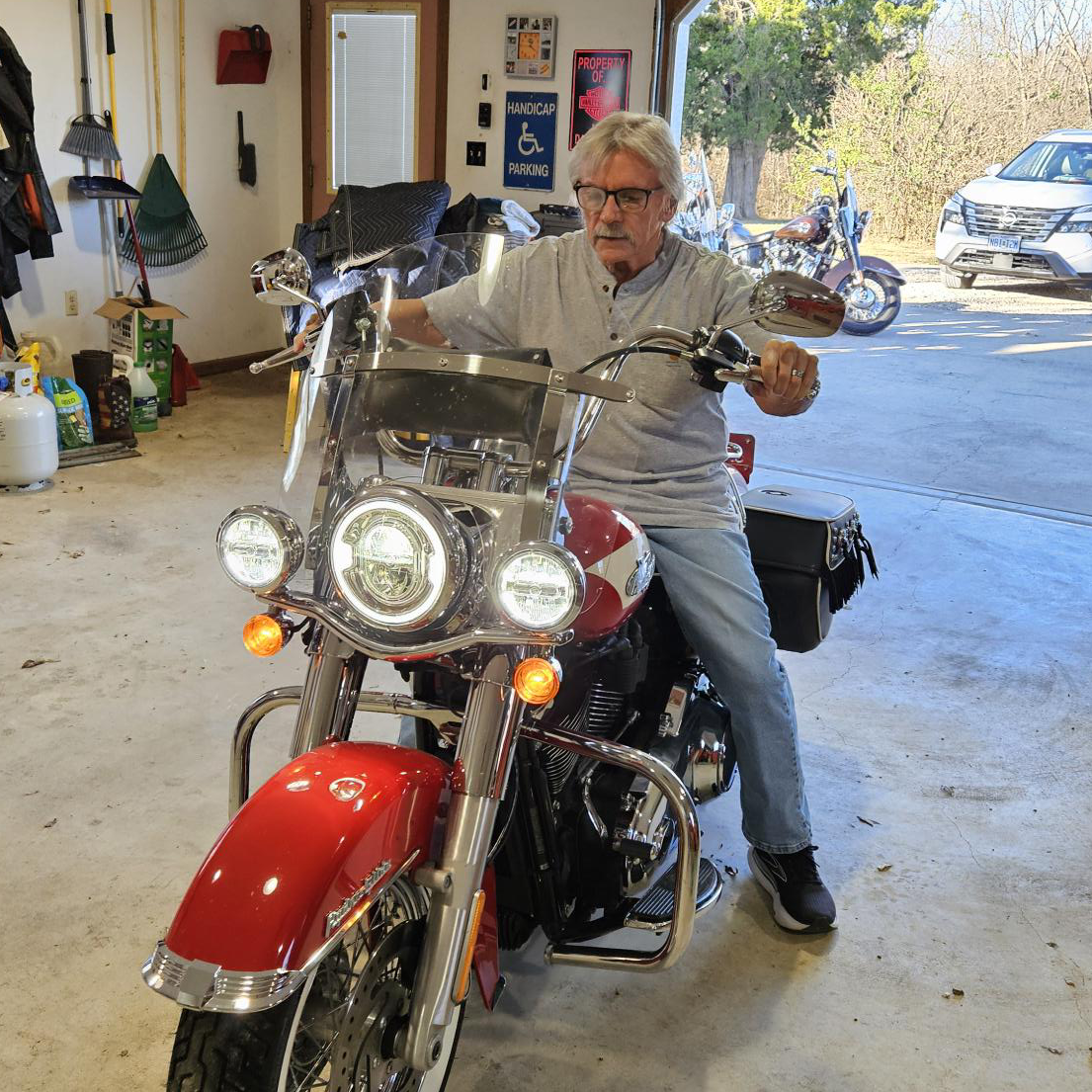
On Oct. 1, 2025, Bill Selley, 77, woke up on the floor of his Crieghton, Missouri, home and couldn’t move.
He started his morning exercises around 6:30, passed out some time after, and woke up around 8 a.m. after hearing knocking at his door. His wife, Kathy, had already left for work. The knocks grew into bangs as Bill struggled to answer the door.
He was experiencing a stroke alone in his home and had no idea. The clock was ticking.
During a stroke, the brain loses approximately 32,000 neurons per second. Bill needed immediate care to help prevent serious neurological limitations.
But with his neighbors in small-town Missouri and an expert stroke team in the big city, time—not distance—helped Bill overcome his stroke.
Minutes late
While time was working against Bill, the clock saved him.
Bill typically arrives at work by 7:45 a.m. When he didn’t arrive by 8:02, his coworkers were concerned enough to call Kathy and pay their house a visit.
It was his coworkers’ knocking that roused Bill. They immediately recognized the signs of a stroke and called 911. In a small-town community, Bill says, it’s easier to know when something is off between neighbors and colleagues.
“A lot of people aren't fortunate to have a community like this,” he says. “I could have been lying there all day, and I don't know what would have happened. I don't know if I would have lived or not.”
Kathy rushed home as the emergency medical technicians (EMTs) arrived and asked for Bill to be taken to Saint Luke’s since she knew its reputation for stroke care. They hurried Bill to Saint Luke’s Hospital of Kansas City via a LifeFlight Eagle helicopter.
What time can’t tell
Once Bill arrived at the hospital, his intake team performed an MRI. Without knowing the exact timing of the stroke, they weren’t sure if he was still within the four-hour window to administer clot-busting medication, commonly used to treat ischemic strokes.
Thrombolytics (clot-busting drugs such as tPA or tenecteplase) traditionally have a strict three- to 4.5-hour administration window because the benefit of restoring blood flow sharply drops over time. Simultaneously, the risk of fatal brain bleeding drastically increases.
But with new diagnostic tools, Saint Luke’s stroke team, led by Karin Olds, MD , relies on more than just the clock: They rely on the brain itself.
“We have a new WAKE-UP stroke protocol that we use at Saint Luke’s,” Dr. Olds says. “It uses a fast-scan MRI to determine if there’s salvageable brain tissue for somebody who wakes up with symptoms or doesn’t know exactly when the symptoms started.”
The WAKE-UP protocol is designed for patients who have a mismatch between two scans: A diffusion-weighted imaging (DWI), which shows where the brain is suffering from a sudden loss of blood flow, and fluid-attenuated inversion recovery (FLAIR) imaging, which shows increased fluid content surrounding the brain.
When the DWI and FLAIR scans don’t align, it means the stroke likely occurred within the last 4.5 hours, giving the medical team more options for successful treatment.
Despite not knowing the exact time of his stroke, Bill’s was within that window and received the clot-busting injection tenecteplase.
“I think that's what saved him,” Kathy says.
Turning back the clock
After receiving the TNK, Bill slowly regained his strength and ability to speak over the next couple of days.
Bill was soon transferred to Saint Luke's Rehabilitation Institute, where he did three weeks of physical, occupational, and speech therapy. When he was well enough to go home, he spent the next three months in outpatient rehabilitation.
Bill was good about staying in shape, and his underlying fitness helped his response to rehabilitation. Many of the exercises he encountered in rehab were already part of his daily routine.
“Recovery is different for every person,” he says. “Just keep a good attitude and follow the programs as closely as you can. I just thank my lucky stars I'm still here.”
Today, even with continued right-side weakness, Bill does 40 push-ups a day, lifts weights, stretches, and works to improve his balance. He’s back to working three days a week at an auto-parts store, which is physically demanding on its own.
With his commitment to his recovery program, Bill is seeing small but noticeable improvements each day. Aside from blurry vision, Bill is living much of life he had before the stroke.
He looks back at all who helped him: his coworkers for caring enough to check on him, his wife for taking him to his appointments, his 13 grandchildren (and three great-grandchildren) for giving him the strength to keep going, and his care team at Saint Luke’s whose WAKE-UP stroke protocol helped him make up for lost time.
“Without everybody, and I mean literally everybody's performance and participation in this, I wouldn't be where I am today,” he says.
Saint Luke's Hospital of Kansas City and Saint Luke’s Marion Bloch Neuroscience Institute have consistently earned several prestigious honors for stroke care, including by The Joint Commission as a Comprehensive Stroke Center, and the state of Missouri as a Level I Time Critical Diagnosis Center for Stroke. Nationally, Saint Luke's beats key benchmark numbers for stroke care.
Relevant News
Patient Stories
Wife’s Quick Thinking Helps Husband
Patient Stories
Emergency Heart Care Helps Joan Celebrate Life’s Big Moments
Patient Stories
Healing in Harmony: How Music Helped Bob Recover After Stroke
Patient Stories
Runner Finishes Half Marathon 144 Days After Heart Surgery
Patient Stories
Gastric Bypass Journey Opens Door to New Adventures
Patient Stories